
Mainstream economics teaches us that the economy runs on production and consumption. Producers produce, consumers consume. One creates goods and services, the other pays for and uses them. Between them, they are the heartbeat of any functional economic order.
But there’s a third force not discussed enough in mainstream conversations, one that rarely shows up in textbooks, but quietly dominates the whole system: the extractors. Extractors are the oligarchy. Extractors are the deep state. Extractors are the Illuminati, the Freemasons, the “Elders of Zion” everyone has been looking for.

Click here to see full diagram.
No need to go looking back in the shady alleyway behind the Federal Reserve or the World Economic Forum for the secret Satanic cult planning the next global crisis, they do it right in front of us!
And I already checked back there anyway.
The Real Economy: Producers and Consumers
Let’s start with the basics. Producers use land, labor, and capital to create wealth. These are the classic factors of production. Capital, in its truest and physically real form, is simply wealth reused to create more wealth (factories, tools, infrastructure). Producers take on risk, organize resources, and pass on the costs of taxes, tariffs, rent, and labor to consumers. No blame!
Consumers, on the other hand, are often treated like economic afterthoughts, as if shopping were some kind of first world frivolous luxury instead of a basic economic function. But consumers bear costs. They pay taxes, producer prices, and economic rents. They drive demand. They make production worthwhile. And average Americans, despite being caricatured as mindless consumers (though we are fat as shit), are among the most over-worked consumers in the world.
Consumers means people with jobs AND the dependents and families that rely on the wage earners. I wrote an article a while back about turning our consumer society into a creator society. While I still mean everything I wrote, I want to clarify that I mean consumers should also embrace their roles as producers of wealth and value through whatever means they choose, and not box themselves into the corner of simply being walking wallets for other producers.
This relationship between producers and consumer is symbiotic. One cannot exist without the other. When recessions hit, it’s often because there’s overproduction met with underconsumption. When the two are out of balance, the system is de-stabilized.
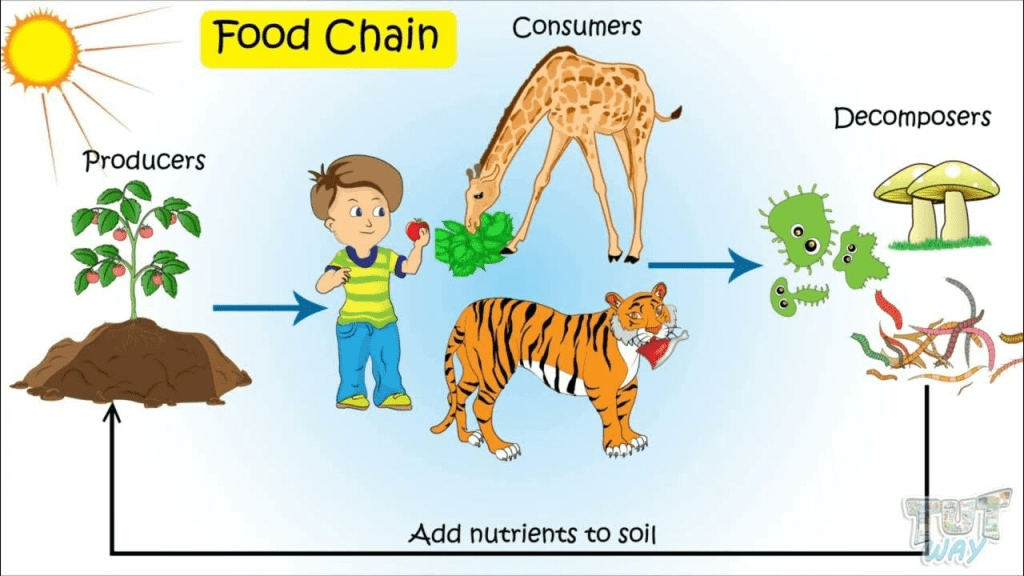
Just as in the food chain model of ecology where there are producer and consumer organisms, there are also “decomposers” which I find to be an excellent metaphor for extractors of economic wealth. Decomposers serve a role, but they can also decay and kill producers and consumers when left to fester and take over the ecosystem.
The Missing Third: Extractors
So where do extractors fit in? Extractors, by definition, appropriate wealth without producing it. They don’t create. They don’t consume in the normal sense either. They accumulate wealth. Marxists made the mistake of thinking accumulation of capital and wealth happened on its own like a law of physics, when accumulation is done by extraction most of all.
In feudal times, the extractor was often a local lord or king demanding tribute or taxes. Before that, it was the conquering ancient army leader extracting slaves and treasure from the villages and towns they plundered.
Today, the extractive class is a complex, often hidden network: landlords collecting unearned rent, banks collecting interest on money they didn’t labor to earn, and private insurance monopolies charging excessive rates and premiums because their industry is anti-competitive and encourages price raising instead of price lowering.
Extraction is not the same as production or consumption. It’s the transfer of wealth from those who earn it to those who don’t. It includes:
- Land rent
- Taxes
- Debt costs
- Financial speculation
- Plain old blue collar criminal theft
- Economic value loss from disasters, destruction or pollution
Even economists often lump extractors into the categories of producer or consumer, blurring the reality. But recognizing extraction as a distinct force reveals what’s broken in our system.
Privatized Extraction Is the Real Problem
When extraction is privatized, that is, when individuals or corporations are allowed to claim economic value simply because they hold a legal monopoly rather than producing anything of value, the economy becomes unbalanced.
Landlords often justify rising rents by claiming they’re providing a place to live. But the building may have been constructed years ago by a real producer, and the land value rises because of public infrastructure and community demand, not the landlord’s efforts. Similarly, a thief in a store might look like a consumer or shopper, but they’re simply taking without giving back. Banks charge interest not based on production risk, but on the legal monopoly control over the supply of credit.
That’s unearned economic rent, not productive capital returns.
Michael Hudson and other modern economists have warned that the FIRE sector (Finance, Insurance, and Real Estate) have cannibalized the productive economy. When unearned extraction is treated as equivalent to earned income, policymakers prioritize Wall Street over Main Street. That’s why bailouts go to bankers, not workers. It’s why stock prices matter more to the Fed than declining and stagnant wage rates.
The Georgist Insight: Harmonizing the Three Forces
Georgism recognizes that all extraction must be treated as common property, while allowing production and consumption to remain private and free.
This means:
- Taxing land value instead of labor or capital
- Returning rent, interest, and resource wealth to the public as a citizens’ dividend
- Eliminating taxes on production (income, sales, tariffs) and letting the economy run efficiently
This is the real meaning of laissez-faire, as the Physiocrats (a.k.a. “Les Économistes”, or the original economic thinkers of 18th Century France) intended: let production and consumption be, and tax only that which is extracted, not earned.
Mason Gaffney’s ATCOR principle: All Taxes Come Out of Rent, explains how hidden extraction harms everyone. When private rent is untaxed, governments turn to taxing wages, goods, and business activity. This distorts prices, hurts investment, and depresses productivity.
The Soviet model failed because it tried to centrally control consumption and production, ignoring the subjective theory of prices and value that brings costs down to what people can afford and are willing to pay. But so too does our model fail when we allow extraction to fall into private hands and force producers and consumers to carry the burden.
Two Classes: The Rentier and the Renter
We need to stop thinking in terms of workers vs. owners or capitalists vs. labor. The real divide is between private extractors and everyone else.
- The rentier class extracts unearned wealth from land, monopolies, and finance.
- The renter class (workers, consumers, small business owners) earns through labor or productive enterprise and pays rent to exist.
This is the true class divide. And rent is the hidden language of it all.
A Call for Georgist Policy
When the next recession hits, and it will, we need leaders who understand this. We need politicians who will tax private extraction and untax productive labor and enterprise. Who will replace endless policy complexity with a simple principle: publicly created wealth belongs to the public.
Fund healthcare, lunchtimes for babies in school, roads, and public infrastructure through land value taxes and natural resource rents. Provide low-interest credit to productive businesses by taxing the unearned income of for-profit banks and private equity firms. Issue public dividends to every citizen. Remove taxes on work and sales. This isn’t utopia, it’s economic sanity!
Until we recognize the third force of extraction and reclaim it for the public good, we’ll remain stuck in a system where the few take all, and the many pay for it.
Let producers and consumers be.
Let extractors foot the bill.
—
The Homeless Economist

 The Daily Renter
Leave a comment