
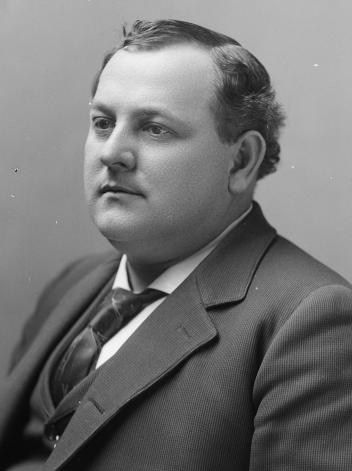
The articles that inspired this post for further reading: The Amazing Tom Johnson, Tom L Johnson – A Pillar of Progressivism, Tom L Johnson – Best Mayor in the US, New Life in Old Cities
Background
Cleveland is a city that’s currently on the decline, with a population less than half of its peak around 1950, it’s clear that the once great city needs a mayor who can revitalize it. The answer may just lie in the movement of the man that brought the city to said greatness.
Back at the end of the 19th century, Cleveland was a small city of about 100,000 people, and it was growing fast. Alongside this increase in population was an increase in attraction, and one of the men who were attracted to Cleveland’s rise was Tom L. Johnson.
Tom L. Johnson: The Greed-Driven Robber Baron
Johnson was a man in his 20s looking for ways to gain wealth quickly, at a time when the United States was undergoing rapid industrialization. As it turns out, Johnson was smack dab in the middle of the Gilded Age, where the most powerful fortunes were made not through producing and providing goods and services as a laborer or a capitalist, but by controlling the resources used in the production process which were non-reproducible. The great key to wealth was being a monopolist.
Seeking to ride this wave, Johnson acquired massive interests in the street railways of Cleveland and other growing cities of the era, where the rise in population and the resulting rise in demand for Johnson’s land and rail lines could give him vast amounts of wealth without providing anything in return. But he didn’t stop there. Johnson then went further and obtained railway patents that ensured none of his competitors would be able to reproduce the services his railway interests provided, giving himself unbridled power at the cost of the rest of society.
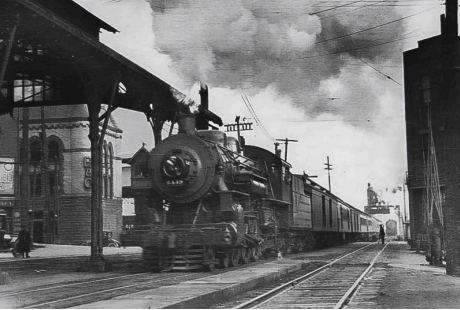
With ownership over all of these non-reproducible natural resources and legal privileges combined, Johnson obtained the power to extract wealth from the people of Cleveland and others who were forced into his monopolistic services, their wealth flowing to his pockets without anything in return.
It was at this point that it seemed Johnson’s legacy would be set. He would go down as a Robber Baron, one of many men who lived in infamy among an age of suffering; monopolists of the Gilded Age who got rich by lording over the income of hard-working laborers and truly investing capitalists. His path was set out for him and his bed was made, and nothing, it seemed, would take him off this course.
Or so it was, until a chance meeting led him down the path of personal reform and eventual redemption, started by reading and then meeting the reformer who would become his personal hero and his greatest inspiration. While riding on a train from Indianapolis to Cleveland, a train conductor encouraged Johnson to read a work called Social Problems, one of the most popular books in the catalogue of Henry George.
While he was reluctant at first, he eventually gave in to the conductor’s demands and read George’s book. It changed his life. Social Problems profoundly impacted Johnson’s outlook on both his actions and the nature of the Gilded Age, to the point of causing a complete reversal in his moral character. In his newly reformed eyes, he had been contributing to the great evil that had kept progress from lifting all in society up. What was once his source of wealth and power—the private income he reaped from his non-reproducible resources and privileges—had been revealed to him as his true great enemy.
The course that Johnson was supposed to take, the course of rent-seeking at the cost of true production, had been derailed in favor of the opposite. Johnson became a firm believer that those who produced and provided must be protected and empowered, while those who extracted wealth in the way he had as a monopolist needed to have their powers dismantled.
It was from the ashes of this original derailment that a new Tom L. Johnson arose.
Tom L. Johnson: The Reform-minded Georgist
Tom Johnson’s personal reform culminated in a meeting with Henry George, where the now extremely popular reformer encouraged him to enter politics.
In 1901, after some years of trying and George’s death a few years earlier in 1897, Johnson achieved his highest post by running for mayor in the city of Cleveland. He ran on a Democratic platform advocating to undo the harms his old self and other monopolists of the time had inflicted on the people of the rapidly growing city.
Johnson won the mayorship and immediately went to work. He fought against the city’s natural monopolists in the rail and utilities industries by forcefully reducing the fares charged by the former and publicizing the services of the latter. He reclaimed land his predecessors had been preparing to sell to the railroad barons of the city, and he helped foster public parks and infrastructure.
Perhaps most importantly, Johnson implemented a new system of real estate evaluation that targeted the value of Cleveland’s non-reproducible land. This brought in significant revenue from the ultra-wealthy landowners of the city. The new revenue system taxed the same type of land profiteer Johnson himself had once been, and it allowed Cleveland to grow both efficiently and equitably.
Johnson was incredibly popular, winning reelection three more times and serving a mayoralty of eight years, from 1901 to 1909. During his time as mayor, he transformed Cleveland into a thriving city, roughly four times the size it had been when he first took office.
Unfortunately, the strain and effort Johnson put into advocating for the ideology that reformed him took a toll on his health. In 1911, just two years after retiring from the position of Cleveland’s mayor, Johnson fell gravely ill and passed away. He left behind a lasting legacy of standing up for the people most in need.
Tom L. Johnson: A Heroic Legacy
Johnson left behind a legacy of heroism, aiding Cleveland at a crucial inflection point in American history in a way that would not be forgotten. Eighty-four years after his final days as mayor, a 1993 survey by Melvin Holli ranked Johnson as the second greatest mayor in United States history, second only to Fiorello LaGuardia of New York City.
Johnson had a statue built in his honor, and in that statue’s right hand is a sculpture of Henry George’s masterwork, Progress and Poverty.
Cleveland is a city that seems to have lost much of its greatness, but what has been lost can be found again. The key lies with the personal hero of the man who brought Cleveland its greatest days. The words of Henry George are the words Cleveland needs to hear today.


 The Daily Renter

Leave a comment