

I know it’s been a little while since the last part in this series, but for now this article will serve as a little reboot. There are still many sources of economic rent to be covered, and this series may receive intermittent updates as time goes on. But all that aside, the topic of this article is a particularly far-reaching one, licenses which are limited in supply and act as gatekeepers of access to several occupations and operations, making access to them non-reproducible. Let’s dive in.
Introduction
New York City in the late 1920s and early 1930s was a bad time to be a taxi driver. Between the up-and-coming rise of the automobile and the fight for recognition, to unregulated cracks in the new industry and battles between taxi drivers and the owners of their fleets, the taxi industry was caught in a storm of legal and social trouble.
The ailments of the fledgling taxi industry even got so bad to passengers being unsure if their driver was a criminal, or perhaps they even engaged in crime themselves by using taxis to access bars during the Prohibition era.
It was clear a set of guidelines was needed to steer the taxis of New York down a better path. So, starting in 1937 under the Haas act, the administration of then-mayor Fiorello LaGuardia began granting taxi medallions, a legal privilege whose supply was restricted to prevent too many taxi drivers from entering the industry, thus bringing them closer to their demanded level.
With the new system, when all medallions for a given year were granted, access to them, and to positions within the taxi profession as a whole, became unavailable by all excluded. The value of these medallions was effectively economic rent, the income from controlling a non-reproducible asset.
While this system worked great initially, the unchecked and untaxed economic rents of these medallions began to spiral out of control. Around 75 years after their creation, taxi licenses had changed from a regulation that brought aid to the industry into its own worst nightmare,
selling for about 1 million dollars each.
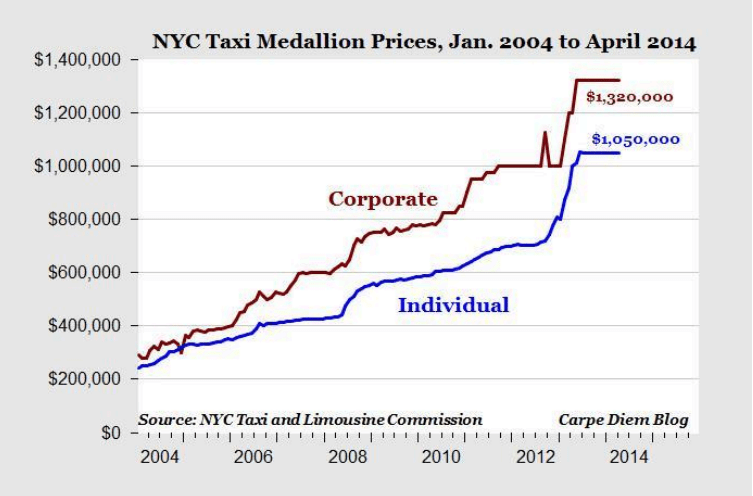
Taxi medallions are a show of the greater problems that can be seen with limited licenses necessary to enter an occupation. They hurt industries, workers, and consumers all to benefit the economic rent-collectors of these legal privileges. Let’s examine the full effects.
Higher prices, Lower Employment, Worse Inequality, and Greater Inefficiency
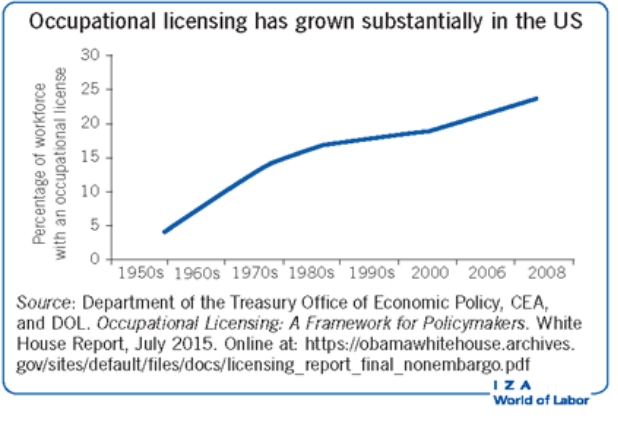
Licenses are a mainstay of dozens of major professions across the world. For the United States, it can range from doctors, to lawyers, to even barbers. The number of licenses that are created each year for particular professions are regulated by state governments, but the process of license creation is also heavily impacted by professional organizations, groups dedicated to a particular industry and its
practices.
Some notable examples include the American Medical Association (AMA) and the American Bar Association (ABA). One of the powers granted to professional organizations is the ability to lobby for state governments to restrict the supply of licenses, and by extension job opportunities, to their particular industry, which these organizations are infamous for.
The owners of the limited licenses that do exist are able to extract higher wages for themselves, often referred to as a wage premium. These higher wages are, in essence, economic rent, and the cost? Higher prices for consumers who directly pay for services, lower employment for those seeking to enter the industry, fewer services for society as a whole, and the rich get richer while the poor are left
behind to suffer.
This is a problem that persists even outside of the labor market. Another example of limited licenses being used to extract economic rents are in Certificate of Need (CoN) laws that are used to limit the supply of hospitals and other facilities dedicated to healthcare. In essence, these laws make the very investments needed to save lives and improve the health of society non-reproducible, to the benefit of the heads of already-existing healthcare facilities who are able to reap massive economic rents by being absolved of competition.
By making positions in a particular profession non-reproducible, owners of limited licenses are able to extract from society without giving in return. Higher prices for fewer opportunities and worse services. It’s clear that a fix is necessary.
The Fix
Like with another legal privilege this website has previously discussed, intellectual property, there’s a fork in the road to dealing with the problem of licenses and their economic rents.
One primary option is abolition. Simply doing away with licensure and limited licensing entirely (like how several American states have abolished Certificate of Need Laws) or replacing licenses with another system like voluntary certification, where licenses aren’t required to enter an industry and instead a certificate can be voluntarily gotten by a worker to show their skills and expertise. This way, anyone can access an industry without incumbents, mainly represented through those
aforementioned professional organizations, barging in to block them.
If abolition doesn’t fit the bill, another option is taxation. Simply taxing the value of these licenses to get as much of their economic rent as possible could ensure whoever owns licenses has to match the legal privilege with a holding cost. Access to the industry would remain restricted, but license-holders would be required to compensate the rest of society for getting the exclusive right to work in a particular profession. With this, society can potentially recoup some of the damages done by
industries having restricted entry; and while not much literature has been made on how taxes can be levied, one possible choice is a self-assessed Harbarger tax, which has already been proposed for patents.
Regardless of what option is chosen, one truth remains clear: rent-seeking from limited licenses that make professional positions restricted and non-reproducible is an issue that permeates many of our key industries, hurting the industry itself and any who rely on it for goods, services, and even potential employment. While certifications are justifiable to ensure consumers know who to trust, limited licenses are a version of a certification system that come with several downsides, ones that require extreme care and compensation. Our current system has failed to treat licensure and its resulting rents with the standard of caution required, and we are paying for it dearly.

 The Daily Renter
Leave a comment