

Society has made tremendous strides in technology over the past few decades. Where just a few decades ago we had flip phones used mainly for calling and messaging and box TV sets, we’ve moved on to flat screen TVs and more general-purpose phones where we can play mobile games or scroll social media.
In step with these advancements have been tremendous increases in connectivity. More people across the planet are connected to the internet than ever before, a powerful display of human progress.
But there’s a catch: while there have been massive improvements in the ability to make use of the digital world, there has also been an advent of large corporations basing their power in controlling the digital world. Among these large technology corporations, often referred to as Big Tech, are five major players in the game: Amazon, Apple, Microsoft, Meta (formerly Facebook), and Alphabet (the parent company of Google).

These five have been enormous players in the digital space for quite some time, with more recent entrants including Nvidia and Tesla. This technological elite has obtained their power by fencing off the competition, which spells massive trouble for the economy and society.
To tackle this, we need to understand where Big Tech draws much of its power from, and how the ideas of a forgotten 19th century economist by the name of Henry George, can be the answer to the questions brought on by the new age.
Fencing Off the Competition
There’s a simple, yet powerful truth that will underpin our investigation into how we can fix the problems found within digital centralization now:
Big Tech is one of the largest users of resources which are non-reproducible, and they don’t pay compensation.
Even if it’s not the end-all be-all of what makes digital oligopolists so powerful, many of the problems associated with them can be found in their ability to either privatize or not pay for what is known as economic rent, the income of a resource which is non-reproducible.
To visualize this, let’s take a look at how Big Tech exploits 3 very important categories of non-reproducible resources: patents and copyrights, the electromagnetic spectrum, and finally, physical natural resources
Patents and Copyrights
Patents and Copyrights (which I’ll call P&Cs for brevity) are legal privileges rewarded for discovering an innovation. However, they reward the innovator in a risky way, by making the use of said innovation non-reproducible by anyone other than the owner of the patent or copyright.
When left unchecked, P&Cs can be used as a weapon to prevent potential competitors from accessing the same tools and capital needed to get a foothold in a certain industry. As it turns out, Big Tech owns an enormous armada of them.
Just looking number of active patents the big five own will show this well enough:
Apple: 98.761
Amazon: 27,389
Alphabet (owner of Google): 83,641
Meta (formerly Facebook): 16,723
Microsoft: 70,676
Is it any wonder Big Tech is able to thrive when they control tens of thousands of active patents on new technological developments, alongside many copyrights over important innovations like software code, ready to use as a weapon against any possible competitor who may reproduce these innovations to put themselves on equal footing?
The potential for market power from obtaining exclusive control of knowledge is damning. Take, for example, Amazon’s patent over the one-click checkout; filed in 1997 and lasting until 2017, the patent effectively granted them exclusive control over the incredible customer convenience of checking out an online order in one click. The convenience Amazon had just obtained and used to exclude all of its competitors played a key role in its rise to power, helping it transform into one of the most powerful online retailers on Earth. For its role it played in that meteoric rise to power, the one-click patent is believed to have been worth billions.

That was just one patent, and while other P&Cs may not have the same impact, being able to control tens of thousands of them gives ludicrous privilege to the biggest in the game. A plethora of practices employed by Big Tech revolving around P&Cs as the most prevalent form of IP law allow them to slaughter the competition and grant themselves tremendous amounts of unearned income.
The numbers back this up, as showcased by Jeff Smith in his article, “No Trespassing on the Fields of Knowledge”:
“McKinsey& Company, which gets coverage in the Wall Street Journal (e.g., Jan 10, 2007) for tracking financial assets worldwide (totaling $140 trillion in 2005), estimates that as much as 80% of stock price is accounted for by those little pieces of paper allowing monopolies on knowledge. The US stock market is now about $22 trillion, so $17.8 trillion would be the price of IP, and about $1.8 trillion would be the annual rental or leasing value of IP.”
While not all of the value of intangible assets stems from patents and copyrights, a huge portion does, which gives untold hundreds of billions, if not over a trillion to their owners in monopoly income. Not only that, these numbers from Smith were given in 2016, almost a decade later and they have certainly risen.
Controlling the innovation space is an incredibly important key to centralization and anti-competitiveness, and much of the power we see with Big Tech stems from their P&C holdings giving them non-reproducible rights to use certain innovations. This legal power is a massive beast already, but it’s not the end of how Big Tech gets its power. Another notable example exists in natural resources, particularly in a form we can’t physically touch.
The Electromagnetic Spectrum
The electromagnetic (EM) spectrum, in particular radio frequencies, is fundamentally important to the information age. It serves as the primary way our devices give and receive data to get all the digital services we need. However, there exists a massive caveat: the EM spectrum is a non-reproducible resource bound by the laws of nature. Unlike the patents we just covered, we didn’t legislate its existence, we instead harnessed its possibilities in a similar vein to land. And much like land, its use is exclusive, in the words of NASA themselves:
“The spectrum is scarce; at any given time and place, one use of the frequency precludes its use for any other purpose.”
Owing to this simple truth, there have been attempts at finding ways to optimally regulate the use of the spectrum. In the United States for example, the department dedicated to regulating use of the spectrum for non-government purposes, the Federal Communications Commission (FCC), started auctioning off spectrum ownership rights in 1994. Per a report written by the department in 2023, the auction system has raised about 233 billion dollars in revenue across a span of 29 years.
These licenses are exclusive, so whatever portion of the EM spectrum is covered under them, can not be accessed by non-license holders without serious repercussions. Something to note though is that while the FCC’s auctions have brought in an average of 8 billion dollars annually, those numbers could be a simple drop in the bucket compared to the true value of the EM spectrum, for two reasons:
- Licenses over spectrum rights aren’t re-assessed annually
- Not all spectrum is licensed for exclusive use, leading to its use, especially by major platforms, not being priced in.
This is an issue that pertains heavily to Big Tech, as the EM spectrum is the natural resource they’ve used to build their platform monopolies. Big Tech’s contribution to internet traffic has been increasing heavily, and over the past 15 years they’ve begun claiming control over vast amounts of high power cables in the deep sea, like Google’s Curie. The race for deep sea cable control, themselves a guide that brings digital services to our doorstep, represents the next step in their ever increasing control of data and consumption of bandwidth along the radio spectrum. These cables themselves rely on the exclusive use of another natural resource, more on that later.
All of Big Tech’s platform services, from Alphabet’s Youtube, to Meta’s Instagram, to Microsoft’s, well, Microsoft 365, rely on using the radio spectrum to transmit signals to and from end-users. Take it from their own writings, like when Amazon spoke of their electromagnetic spectrum goals in a letter to the National Telecommunications and Information Administration (NTIA).
But the issue still remains that the EM spectrum is a non-reproducible natural resource whose value comes from the existence of society and the traffic EM waves can carry. Instead of giving society its due share for using it, especially in return for monetizing vast amounts of user data, Big Tech has been let off for little to nothing.
Big Tech accounted for approximately 57% of Internet traffic in 2021; much of which makes use of the radio spectrum in its journey to and from end-users. It’s gotten to the point of telecommunications companies voicing their frustration over the toll the Tech Titans’ traffic takes on their physical infrastructure. Of course, telecommunications companies aren’t off the hook for keeping up to date with paying rent on their spectrum licenses (or the fact that the industry is naturally monopolistic), but they aren’t the only ones lashing out.
Another major group that has been calling for Big Tech to pay dividends for their spectrum use is the National Association of Broadcasters (NAB), made up of broadcast licensees for radio and TV. These calls occurred in the backdrop of FCC proposals to charge Big Tech with regulatory fees owing to their extensive use of unlicensed spectrum.
Again, this is hypocritical, as TV and radio license owners don’t have to pay the full annual income of the spectrum they’ve been granted, denying full compensation for fencing off nature, but it does show how much of the EM spectrum is used by Big Tech without any form of payment to the public. In line with this, the FCC’s proposal was met with retaliation from a variety of associations seeking to keep unlicensed spectrum use uncharged, and among those associations was the Consumer Technology Association, which represents Big Tech.
These calls are a microcosm of the greater battle between spectrum users for access to the airwaves of consumers. Currently we live in a system of two alternatives when it comes to the how the airwaves should be used by the providers of services: either exclusive licenses that are given away with little annual payment to society for the privilege, like in the case of radio or TV broadcasters, or for free without payment from digital giants like Amazon, Microsoft, or Google. However, there is an alternate path that can combine the benefits. In the words of late Georgist economist Mason Gaffney:
“As with all these “exotic” resources, there quickly emerge three camps. The first wants to collect rent publicly. The second dismisses distributive equity and focuses on framing up existing tenure rights. The third camp is solely concerned with asserting the public right, regardless of efficiency. The beauty of taxing rent, of course, is to achieve and harmonize the (professed) goals of the second and third camps. It would have prevailed long since, were the second and third camps more aware and respectful of the validity and sustained power of each others’ half-share of truth.” (Page 29).
In our current system, we don’t take the third path that can benefit all, and Big Tech has benefited mightily from it. In the words of fellow Georgist economist Fred Harrison:
“The same policy mistakes are being made in the Digital Age, as a result of the influence of three agencies. Young inventors are creating the algorithms which can be turned into the platforms to provide new economic opportunities. Second, there are the owners (actual, or by default) of the natural resources: the electromagnetic spectrum and the rights-of-way traversed by fibre-optic cables. And the third player is the government, which sets (or fails to set) the prices for public goods.
…
The under-pricing of the radio spectrum and the rights-of-way has resulted in the absorption of their rental value into the asset prices of Amazon, Google, Facebook and the other Internet based operations.
…
The internet platforms are serving the same function as the aristocratic landlords who owned the green fields beneath which lay the coal seams.” (Pages 9 and 10).
Seeing as how the electromagnetic spectrum is a necessary natural resource that is absolutely scarce, stemming from it being non-reproducible by human hands, while owing its value to the existence of society, it should be treated as a common keepsake whose use by major tech companies and other profit-seekers should be compensated for monetarily. Big Tech is one of the largest users of the spectrum in our current system, and they will continue to use more of it, even if it comes at the cost of other necessary industries.
As we as a species become more reliant on digital communication, especially with the rise of AI, the question of who profits from using the electromagnetic waves will only gain importance.
Physical Natural Resources
Even though we often think of the digital world as an ethereal plane beyond our sense of touch, they’re still very much connected to the real world. Big Tech needs the physical world and its natural resources, like land, water, oil, and the environment, just like other industries do.
However, as is the theme with what we’ve discussed, these resources are non-reproducible. This spells big trouble because Big Tech makes extensive use of these resources without paying anything back in compensation. If we are to break them down individually, we can understand this fully.
When it comes to land, Big Tech has been buying up tons of it for office and retail purposes. In a way that’s similar to the EM spectrum, many of these plots are ultra-valuable due to their geographic location being in the middle of key economic hubs in the United States, like Manhattan. These highly-specialized and valuable locations are needed by all businesses looking to enter a market, so to allow them to be owned without compensation keeps market power concentrated by denying smaller tech companies from buying their own real estate in these hubs. Same goes for data centers that hold the backbone of these companies’ services.
In line with the use of land are the rights-of-way that are traversed by the cables which carry data as electrical signals; which was mentioned in the prior section, particularly by Fred Harrison. Big Tech is starting to use their own deep sea cables to transmit internet traffic, but these cables run along incredibly valuable strips of land that have been set aside for exclusive use by the government without being priced in. Like with ownership of surface level land, users of deep sea rights-of-way take up this non-reproducible space without paying for the privilege, leaving massive amounts of what should belong to the public out of their hands.
Then comes water, which Big Tech needs hundreds of billions of gallons of to keep their data centers functioning. This is a special problem because of where these centers are located, in particularly dry regions where water is incredibly scarce. This is a problem that will only get worse with the rise of AI if left unchecked.
As it relates to oil, its sources can’t be reproduced just like water, but even worse, the depletion of oil sources is permanent. While this problem isn’t just limited to Big Tech, and can instead be broadly applied to our reliance on fossil fuels as a whole, it does speak to the carelessness with which we treat our non-renewable resources. The rise of AI forecasts this, as ChatGPT alone used about half a million kilowatts of energy daily in 2024. With the continual rise of the AI sphere and Big Tech’s attempts to capture it, non-renewable resource extraction will only be driven up.

This question of the use and abuse of oil, land, and water all leads us to one last natural resource to study: the environment, more specifically, pollution. As of the end of 2022, the tech industry was responsible for about 4% of global emissions, with Big Tech contributing heavily. Amazon alone released 16 million metric tons of carbon dioxide into the atmosphere, with Microsoft “only” releasing about 900,000, the least of the Big Five.
Seeing as how our natural environment is non-reproducible just like the land, water reserves, and oil deposits we rely on, damaging it imposes a permanent cost on the rest of society. Being able to get away with this damage, without paying compensation, is yet another helping hand in Big Tech being able to expand so furiously without accounting for the costs they put on the rest of society.
As we can see from the use and abuse of all these resources and privileges, Big Tech bases itself in their non-reproducible nature, granting them power by fencing off the competition. This all leads into a very important question:
How do we make them compensate us for exclusively using and abusing these resources?
Correcting the Course through Compensation
If we want to make Big Tech pay its fair share back to society, we have to tax them on the value of the resources they control which, for the rest of us, are non-reproducible.
This is a paraphrase of the ideas of Henry George, a political economist who lived from 1839 to 1897. George recognized that the era he was living in, a time period known as the Gilded Age, was a bit paradoxical. The Gilded Age saw massive improvements in technology that, instead of lifting all boats as part of a rising tide, only lifted a few ultra-wealthy individuals while sweeping the common man under the waves.
George himself was among the latter, being thrown into poverty and unemployment during it. The suffering he bore witness to ignited a burning passion within him to find the root cause of poverty amidst the waves of progress, and to understand how some were able to get so rich while others got so poor as when we as a species advanced our technological prowess.
Eventually, he found the answer. The vast fortunes reigned in by the wealthiest of his day were not gotten through producing and providing goods and services, but instead were derived from hoarding and exclusively using the resources we rely on for production, but which are non-reproducible by our hand.
Be it land, patents, or some other resource of their like; since nobody could make more of these resources to provide at cheaper prices for society, the ultra-wealthy hoarders of these resources, known as the Robber Barons in George’s day, were able to get rich by forcing wealth out of society through the exclusive powers they were granted. This brought both inefficiency and inequality, lifting some up by taking others down and throwing a wrench into the gears that make our economy and society function.
Indeed, where the industrial revolution of George’s time had major inefficiencies and inequalities owing to the monopolization of non-reproducible resources, our digital revolution is undergoing these same issues.
To bring about an end to this, George and supporters of his ideas (known as Georgists) have argued that the income of the non-reproducible resources we rely on should either be taxed or dismantled, and that whatever revenue is collected should be used to replace taxes on the production and trade of goods and services.
To understand how we can apply this to Big Tech, let’s apply these ideas to each resource mentioned above.
Patents and Copyrights
Georgists tend to take different routes when it comes to dealing with patents and copyrights. This was covered in an older article, but to summarize, there are two main pathways for the Georgist solution to P&Cs: Either tax them according to their market value, which can be determined through a mechanism like the Harberger tax, or replace the system with some other form of reward, like a prize system as described by Joseph Stiglitz.
Another reform that has come up recently is to require compulsory licensing by anyone who wants to use the innovation (with royalty payments as a reward of course), something that can perhaps be combined with the tax proposal to open up access to knowledge while compensating society for the monopoly privilege conferred by patents and copyrights.
Regardless of the solution one finds more suitable, the goal is the same between the two: ensure an individual person or company is rewarded for an innovation, without letting them obtain non-reproducible access to that innovation without compensation.
Big Tech, which makes extensive use of the entrenching power of patents and copyrights, would suddenly see one of its largest assets faced with either a financial burden or greater accessibility by their competitors. While rewards would still be available, it wouldn’t manifest itself into the incredible leverage brought on by specific pieces of legal privilege like Amazon and the one-click. By ensuring compensation for exclusive control over innovations, Big Tech would have to sacrifice much of its monetary gains from its leverage in the sphere of patents and copyrights and play on a far more level field.
The Electromagnetic Spectrum
To account for the use of the EM spectrum, the platforms that use the spectrum waves should pay the annual rental value of the frequencies to society. As stated before though, spectrum bands are both licensed and unlicensed, which leads into the ways to value them for annual payment:
Licensed spectrum: To get the annual value of the frequencies they grant exclusive control over, these licenses would need to be reworked into being re-evaluated annually to account for year-on-year changes, effectively charging the license holder an annual rent to the public treasury for their license.
Unlicensed spectrum: While the lack of auctions makes it less straightforward to value, it’s not impossible. There are methodologies that can be useful in finding the true price of a piece of bandwidth when it’s used.
Another possibility is to have a market where exclusive rights to use electromagnetic frequencies can be traded, while charging a tax on the market value of those traded frequencies to account for the exclusive ownership. In turn, efficiency and equality can be ensured by letting spectrum go to those willing to use it efficiently according to its value, without being able to waste it or use it while reaping the benefits at the cost of non-owners.
Regardless of how the non-reproducible waves that power our Internet of Things are allocated, licensed or unlicensed, those companies which use it exclusively should pay us back for drawing income from the key resource needed to power our modern communications.
Physical Natural Resources
Land
Even though Henry George focused on many natural resources and legal privileges, his solution to the land problem would go on to become his most famous. Known as the Land Value Tax (or an LVT for short), it’s designed to collect the value of a plot of land as determined by society through the land market. The tax doesn’t include buildings and improvements made to the land like a property tax does in our current system, so it works double duty in discouraging hoarding non-reproducible plots of land while encouraging improving that land to pay off the tax.
As it relates to Big Tech, they would have to pay heavily for the tens of billions of dollars they hold in the land portion of their real estate, which is especially prevalent in major cities, as the ground portion of a piece of real estate can be more valuable than the built portion in dense areas.
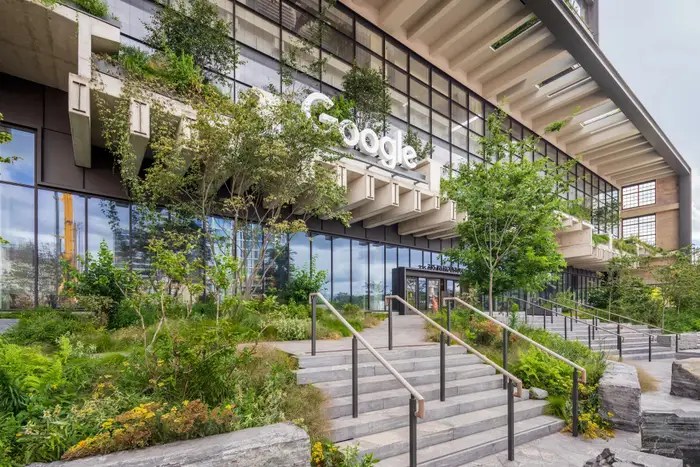
Just like with surface land, the rights-of-way used by Big Tech for their deep sea cables would also be charged for in a Georgist system, allowing those highly valuable strips of land needed for almost all exchanges which occur on the Internet to be accounted for in the public purse.
In turn, Big Tech companies would have to use their holdings of land, above or below the sea level, efficiently to the point of paying off the LVT while compensating those small tech competitors who might’ve lost access to key pieces of ground as a result of high-value land grabs.
Water
Owing to data centers being set up in arid locations with scarce water resources, it’s clear Big Tech, with their tremendous amounts of water use, needs to be charged according to how valuable the water they extract is. To uphold the idea that water should be treated as a common resource, and that depleting a non-reproducible water source should be compensated for, Big Tech and other extractors of water from these arid areas should pay back those who lose access to that water.
One way to do so is in the form of a severance tax on water extraction, as described here by Mason Gaffney in relation to California. In his own words:
“A simple solution to many of our intractable water problems would be a severance tax on water withdrawals. Legally, if you can regulate it, you can tax it. A tax, properly gauged, is an economic price charged by the owner of water (the state of California) for using its scarce property” (Page 4).
This is especially applicable to the arid areas where Big Tech sets up their data centers. The local authorities of those locations can charge Big Tech companies and all other water extractors for the depletion of their sources. In doing so, these companies would have to find a more optimal use for water, or find some other way to reduce their use of our Earth’s scarce water resources.
Oil
Just like water, the extraction of oil from their deposits should be taxed to account for the depletion of said deposits. Taxing the extraction of oil may be even more important than water, as oil deposits are non-renewable and can’t be replenished.
Pollution
The last piece of the puzzle in dealing with Big Tech is accounting for the pollution they emit. The most common answer to the problem of polluting the planet is to levy a tax on the damage caused by the emissions and to charge them to their source.
Like water, the goal is to force Big Tech, and polluters in general, to pay their fair share for depleting the planet of its non-reproducible gifts. Our Earth can not be remade, so to damage it is to exclude others from enjoying it in good health, a transgression which requires compensation.
Make Them Pay Their Fair Share
As we can see, Big Tech is able to get away with much of their oligopolistic power because they don’t pay the cost of exclusively using and depleting the same resources we as a society need but can not reproduce.
Be it excluding others for using a patented innovation or bandwidth grabbing along the electromagnetic spectrum, our digital giants don’t pay their fair share for using these resources.
As stated in the introduction of this article, this isn’t the end-all be-all of the sources of Big Tech’s ability to monopolize the digital sphere. Another major resource not mentioned here is the network effect, to which I regrettably couldn’t find much in the way of Georgist solutions to it or the massive market power it can create.
However, the aforementioned resources already contribute a massive chunk of our digital oligopoly’s power. They serve as a sign that if we want to bring both efficiency and equality to economy, we must do two things:
- Untax the rewards of production and trade, whether it be through working a job or investing in beneficial capital
- Recoup (or dismantle) the value of these non-reproducible resources and privileges on behalf of the public, whose present exclusive use is not compensated for
In doing so, our society and economy can become far more efficient in its productive roles and far more equal in its distributive roles. We still have plenty of time to change the course of our current technological advancements and their impacts on our society and economy. Big Tech, and the problems they bring to both production and distribution, will only be done away with when they finally pay their fair share for the non-reproducible assets they use at our expense.

 The Daily Renter
Leave a comment