
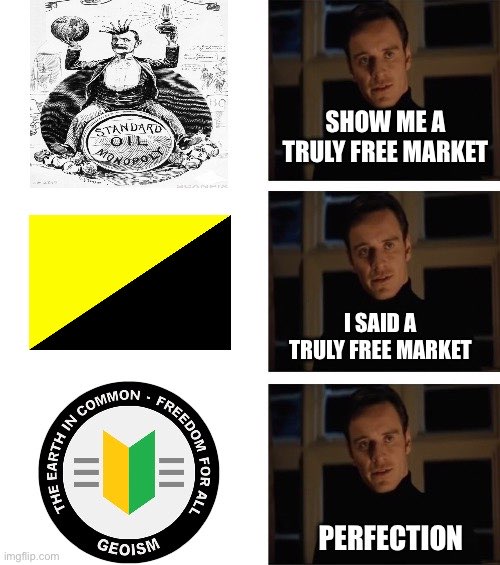
Geoism (link to where the symbol came from), also more commonly known as Georgism, is an ideology that, if I could summarize it in a single line, argues we should untax the production and trade of goods and services and instead tax (or otherwise reform) the ownership of finite resources; resources we can’t produce more of, most prominently land.
The reasoning is simple. When it comes to those things which we can’t make more of, like land, the free market falls flat. Markets rely in changes in supply to match changes in demand, but the thing about land is that its supply is fixed, it can’t change. What happens when the demand for a parcel of land increases isn’t the creation of more of that particular parcel, instead the price of that parcel rises to capture all that new demand, and whoever owns that land gets the riches even if they didn’t do anything. To fix this, you might point to land reclamation as a way to solve this, but that’s not actually creating land, it’s just taking preexisting land from the sea and making it usable. We can’t make more land, so the only way to get it is from those who already own it. This is bad as is, but to add more injury to this already injurious system, private profits in the land invites speculators who hold land, not to use it, but to wait for its price to rise, which increases prices and only snowballs as more speculators pop in and the whole system collapses into a trash pile of unaffordability. A situation which has served as a primary source of calamities like the Housing Crisis. Land ultimately doesn’t mesh with a free market because more land can’t be made to match changes in demand. In fact, it’s often referred to as a monopoly, as summarized by John Stuart Mill. Land and other things like it serve as a core base for monopolistic concentration because, with no new production being possible, no one can compete with its ownership.
The logical result of this, recognized since the times of Adam Smith, is that land is the perfect tax base. Instead of discouraging new growth and production (which can’t happen with land because we’re not making it anymore), it may actually encourage economic growth by forcing out land speculators who drive prices up. A similar case could be for taxing or, if taxing isn’t desired, reforming any other resource which, like land, is finite.
And of course, any revenue collected from any taxation of the finite should be used to untax people producing and trading goods and services to remove any burden from doing them for the benefit of others. If we were to simultaneously let people produce and trade freely, while also kicking out any speculation in finite resources which throw off markets and drive up costs, we could have a market that is truly free to provide what people desire while being far less prone to monopolization both in owning these finite resources and in concentrating industries in general, heavily stymieing all the inefficiencies and inequalities they bring.

 The Daily Renter
Leave a comment