
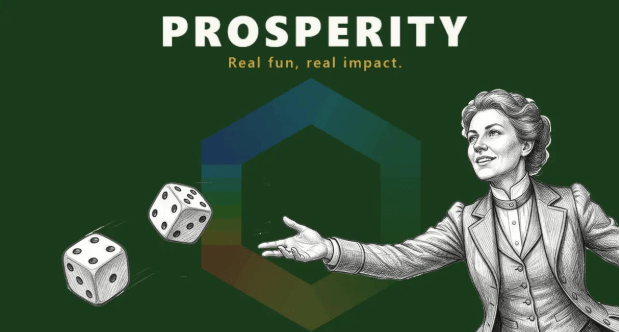
A new online multiplayer game called Prosperity officially opened to the public on June 15, 2026, entering an already crowded digital gaming landscape with an unusually explicit ambition: to make economic philosophy playable.

The browser-based title reframes property competition through the lens of Georgist economics, drawing direct inspiration from the early 20th-century board game The Landlord’s Game and its inventor Lizzie Magie, as well as the political-economic writings of Henry George.
The game was created by Evan Atlas, a New Paltz, New York–born philosopher, writer, entrepreneur, and game designer. Born in 1991, Atlas is the son of author Nava Atlas and artist Harry Chaim Tabak. He is the author of three books and publisher of the Mapping with Atlas Substack, where he explores subjects ranging from game theory and ethics to psychology, complex systems, metamodernism, personal development, and spiritual growth. Those interests converge in Prosperity, a project that combines strategy gaming, economic education, and civic participation.
Atlas describes the project as both a game and a “living model” of competing economic systems.
“The little worlds we call games have the power to reshape the big world we call Earth,” he writes in the project’s accompanying materials.
From “The Landlord’s Game” to Digital Revival
Prosperity explicitly positions itself as a modern reimagining of Magie’s original design, which was intended to demonstrate the social consequences of land monopolization and economic rent.
Magie’s game, created in the early 1900s, is widely regarded by historians as a precursor to Monopoly, though its underlying intent was sharply different: rather than celebrating monopolistic accumulation, it was designed to critique it.
Atlas leans heavily into that historical tension, framing Prosperity as a kind of “restoration” of suppressed game design ideas. In press materials, he argues that Magie’s original economic vision was diluted when her work was later eclipsed by Monopoly.
Two Economic Systems in One Game
At the core of Prosperity is a dual-rule structure that allows players to experience two different economic regimes within a single match.
The first phase, called the “Hoarder Era,” resembles traditional property acquisition games: players compete to purchase land, collect rents, and build wealth through ownership.
Midway through gameplay, however, players vote on whether to transition into what Atlas calls the “Prosperity Era.” In this system, land rents are redirected into a shared public treasury and redistributed equally among players, while buildings and improvements remain privately owned.
The shift is intended to model Georgist ideas about economic rent—specifically the argument that land value is socially generated and should be returned to the community rather than concentrated among owners.
Real-World Incentives and the “Prosperity Pool”
Beyond gameplay, Prosperity also incorporates a charitable funding mechanism tied to paid play. Entry fees from premium versions are pooled monthly and distributed to a selected nonprofit organization, primarily in New York’s Hudson Valley region.
Players participate in selecting beneficiaries through a weighted voting system based on engagement and in-game performance. Atlas describes this as an attempt to connect “game outcomes, civic participation, and real-world resource distribution.”
The project website, which launched alongside the game, describes the mechanism as a “local pilot program” with potential for expansion.
Game Design as Economic Argument
While Prosperity functions as a competitive multiplayer experience, its structure is also explicitly didactic. Players choose avatars representing historical advocates of land value taxation, and in-game systems dynamically adjust land rents based on collective development across the board—an attempt to simulate the Georgist claim that land value is socially produced.
The game also includes cooperative spaces such as parks and “sanctuaries” that reward non-zero-sum outcomes, as well as systems designed to prevent early elimination, ensuring that players remain engaged even after falling behind.
Atlas frames these mechanics as responses to what he calls “race-to-the-bottom dynamics” in both games and real economies.
A Philosophical Throughline
The project situates itself within a broader intellectual tradition stretching from Henry George’s 19th-century critique of inequality to modern debates about housing, taxation, and land use.
By foregrounding Lizzie Magie’s original intent, Prosperity also joins a growing cultural reassessment of early economic board games and their influence on popular understandings of capitalism.
For Atlas, however, the goal is not historical correction alone, but practical experimentation.
Launch and Early Reception
Since its public release on June 15, Prosperity has drawn attention in niche gaming and economics communities, particularly among players interested in simulation games with explicit ideological systems.
Early users have highlighted its hybrid structure (part strategy game, part civic experiment) as both its most distinctive feature and its most controversial one, raising questions about whether games can meaningfully simulate real-world policy tradeoffs.
Still, the project’s framing is clear: Prosperity is not just a game about winning wealth, but about redefining how wealth itself is created, distributed, and understood.
As Atlas puts it in his closing statement:
“The future is already being prototyped in systems we play every day. This is just one attempt to make those systems visible.”


Leave a comment