
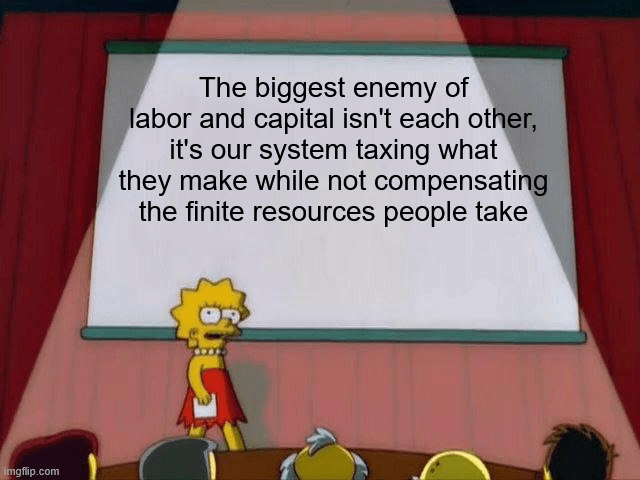
A lot of the issues labor and capital face actually stem from a deeper enemy than the other, one which hurts them both and causes them both problems. Henry George mentioned it in 1883 and it still remains quite true to this day.
When I say finite resources, I mean a whole lot of things: Natural resources like land, exclusive legal privileges like patents or limited licenses, and naturally monopolistic powers. The word “resource” is doing some heavy lifting here but the idea is that any particular privilege which is limited, since we can’t produce more of it, is included in the sights. As it currently stands we allow people to take these finite assets and extract wealth from them without producing or providing anything in return, which hurts both workers and businesses who have to face higher costs of living and production; leaving those who own finite resources richer while squeezing those trapped on the other side dry. It creates a two-tier society that hurts the productive economy while raising inequality, and it can be said that a lot of our most monopolistic companies today which slam the door on competitors and workers alike get their wealth and power in large part by controlling these finite resources, be they resource barons or Big Tech.
At the same time, taxes on production hurt both work and business by putting the costs directly on the workers and productive business themselves. Payroll taxes, sales taxes, income taxes, tariffs, taxes on produced assets (be it as part of a wealth tax or otherwise), and the like all act as a disincentive to produce and provide for each other by adding that extra tax burden. They prevent us from doing what we otherwise could to produce and provide for each other.
The Georgist solution is to reverse course and, instead of taxing the goods and services people make, compensate (or otherwise reform) the finite resources people take. Georgists broadly propose untaxing work, investment, and trade and instead advocate recouping the value of all natural resources, as well as targeting exclusive legal privileges like IP (be it for taxation, dismantling, or some other reform), and dealing with natural monopolies (here’s a set of proposals from late Georgist economist Fred Foldvary).
Labor and capital have a common enemy that hurts them both badly, and while I can’t say if all their woes with each other would be solved by enacting Georgism, both workers and actually competitive businesses would at least be much better off without it.


Leave a comment